Defining Your Style: Fashion Edition
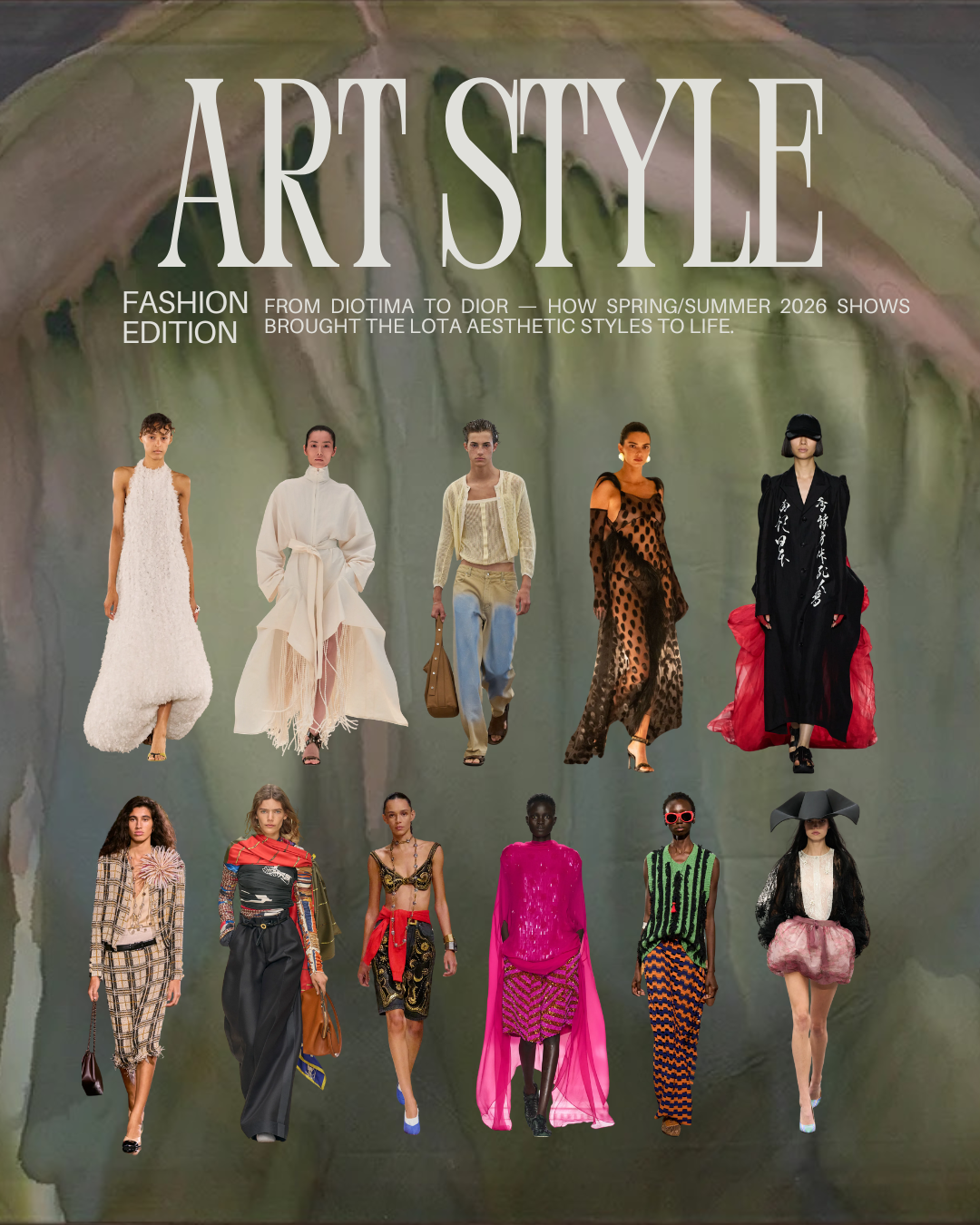
This past week, I caught up with a friend from college I hadn’t spoken to in years (okay fine, decades). We were both engineers in school, part of the same consulting club, and kept moving through the ranks of work as we were all expected to. One of the first things people often ask is: How did you get into art? I had no idea this was something you were interested in. The short answer is that I have always been into it, but never professionally. The longer answer: for a long time, it didn’t feel like I could take that part of myself seriously — not with the expectations I’d placed on what it looked like to be an engineer, or a “take me seriously” kind of person in the world.
I’ve had the privilege to shift careers multiple times since college, some micro moves, some bigger leaps, but the work I’ve created for myself now has let me return to my roots in a way I didn’t think was possible. It’s reminded me that no interest is frivolous. The act of taking something seriously, your curiosity, your taste, your instincts, is what gives it meaning. Especially now as a mother, I think about that often. I try to lean into my kids’ curiosities and remind them that I’ll go down any rabbit hole with them.
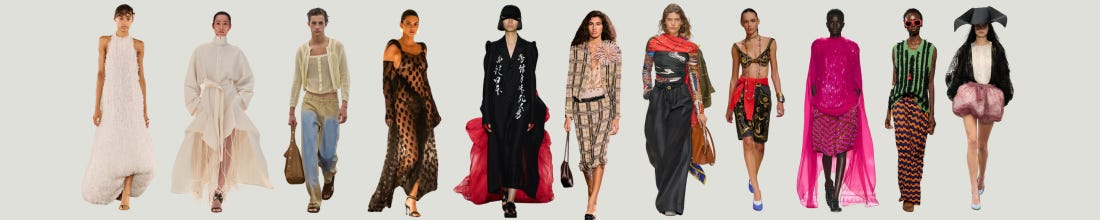
Which brings me to today’s post - a continuation of last week’s piece on the six aesthetic archetypes I’ve been developing through LOTA’s Art Match Tool. This time, I’m looking at how those same six styles show up in another of my favorite art forms that I’ve been leaning back into with all my heart - FASHION.
And like art, fashion tells us who we are and what we value. It is another form of a cultural mirror. This season was full of anticipation, with fifteen designer debuts across major houses from Chanel to Gucci, Versace to Celine. What I loved most was how many of these collections echoed themes we see in art: memory, restraint, materiality, rebellion, storytelling, and so much more.
Let’s get into it.
Organic Modernist
Quiet forms, natural materials, a sense of calm that comes from touch
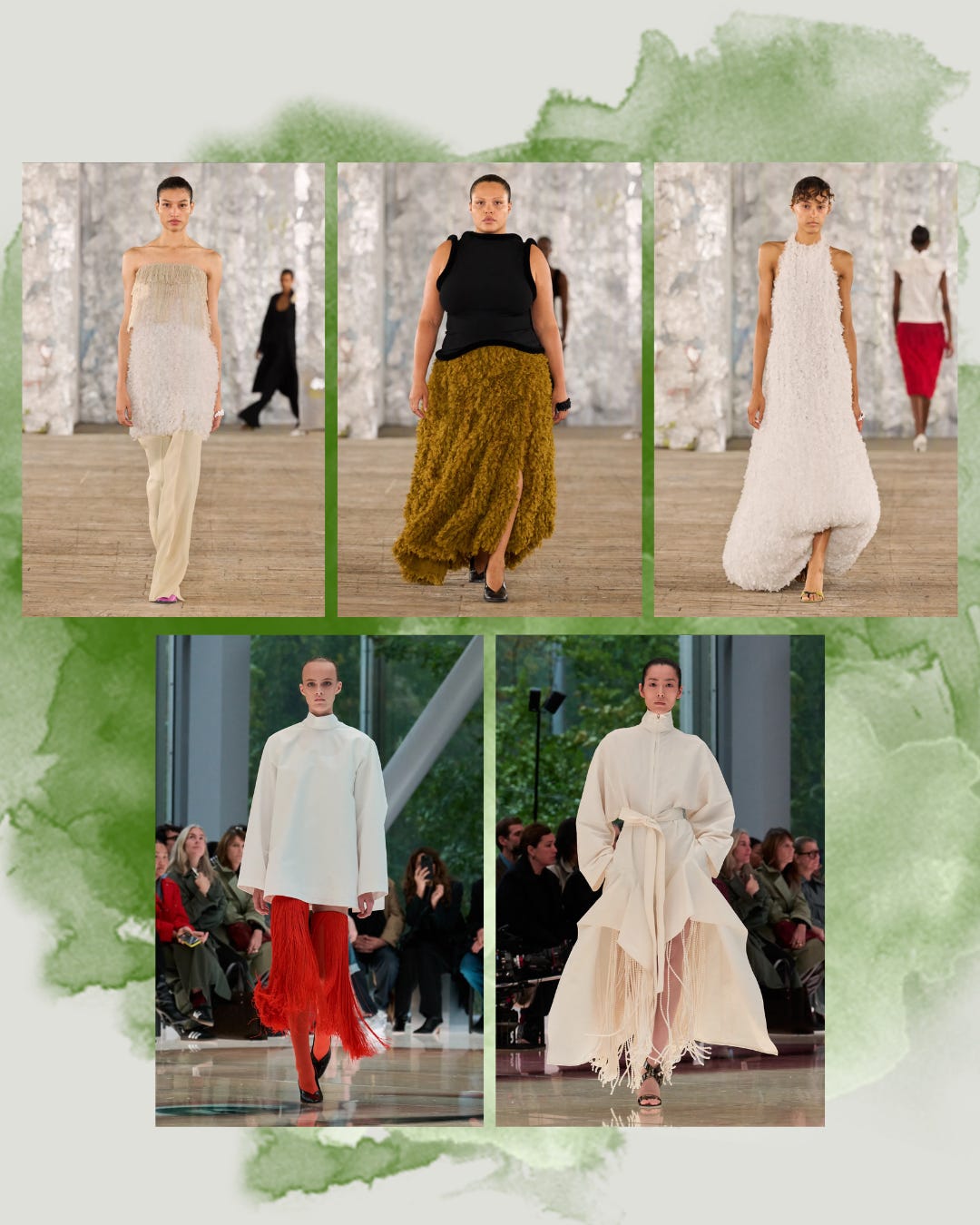
This season, that sense of organic modernism ran through Diotima and Alaïa. Rachel Scott’s “Bacchanal” was rooted in the history of Caribbean Carnival, a radical act of self-expression born from resistance. You could feel that pulse in the work which has become the art form Scott is best known for: macramé fringe, handwoven dresses, and sculptural silhouettes that celebrated craft as liberation. It was exuberant but intelligent, layered with the politics of joy.
At Alaïa, Pieter Mulier turned the same tactile instinct inward. Mulier shared backstage, “I wanted you guys to feel you were in a cocoon for 10 minutes - this thing of an absolute dream - but still with a tension”. His cocoon silhouettes felt protective, tender, and only as Alaïa does, extremely sexy in form. The cascading silk fringe tights and peek-through beading beneath an architectural coat struck that rare balance between precision and flow, walking that line between rebirth and arrival.
Both designers reminded us that craft and material is memory, culture, and care made visible.
Expressive Maximalist
Color, rhythm, and a love of visual energy
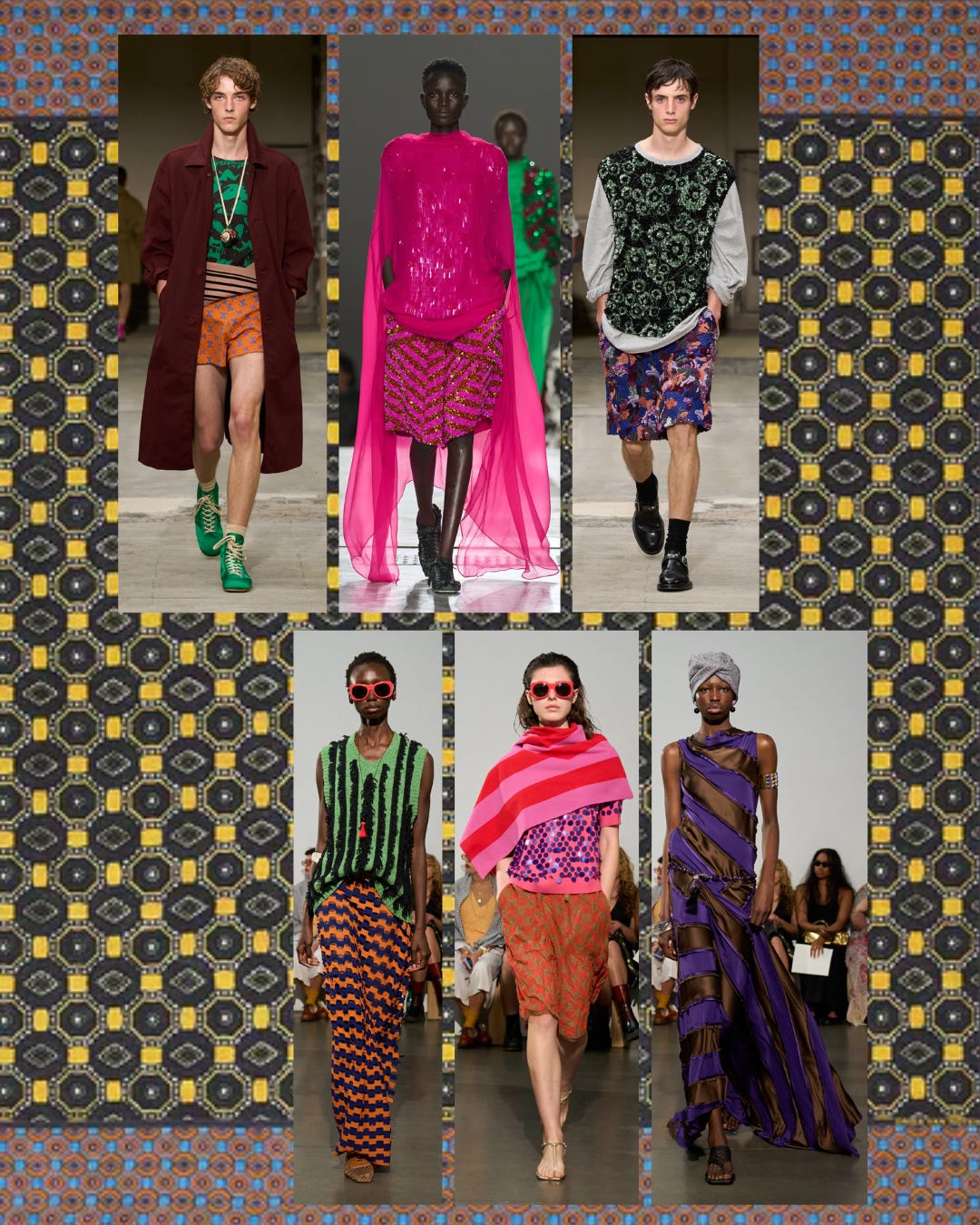
If joy had a uniform, Dries Van Noten would design it. Julian Klausner’s SS26 show for both men and women was sunlit and surf-inspired with lemon sequins, lime silk, flashes of cerise. Borrowing from surf culture isn’t new - we’ve seen the seashells, taffeta surf shorts, and flip-flops return for several summers now. But Dries’s difference is in the dialogue between pattern and color, the visual cacophony that somehow resolves into harmony. Each look was stunning and intentional - as breathtaking from afar as it was in the details.
Zankov carried that beat in his own tune. His playful knits — bold geometry, vibrant color, unique texture — draw inspiration from modern artists like Piet Mondrian and Ellsworth Kelly. For this collection, he turned to women who forge their own path, who express themselves on their own terms. “Even as we expand, we are always going to be very eclectic,” he said, “and give you the opportunity to mix things together in your own way — it becomes a no-brainer.” Spoken like a true maximalist - daring, playful, and free.
Modern Soul
Modern lines with reverence for the past.
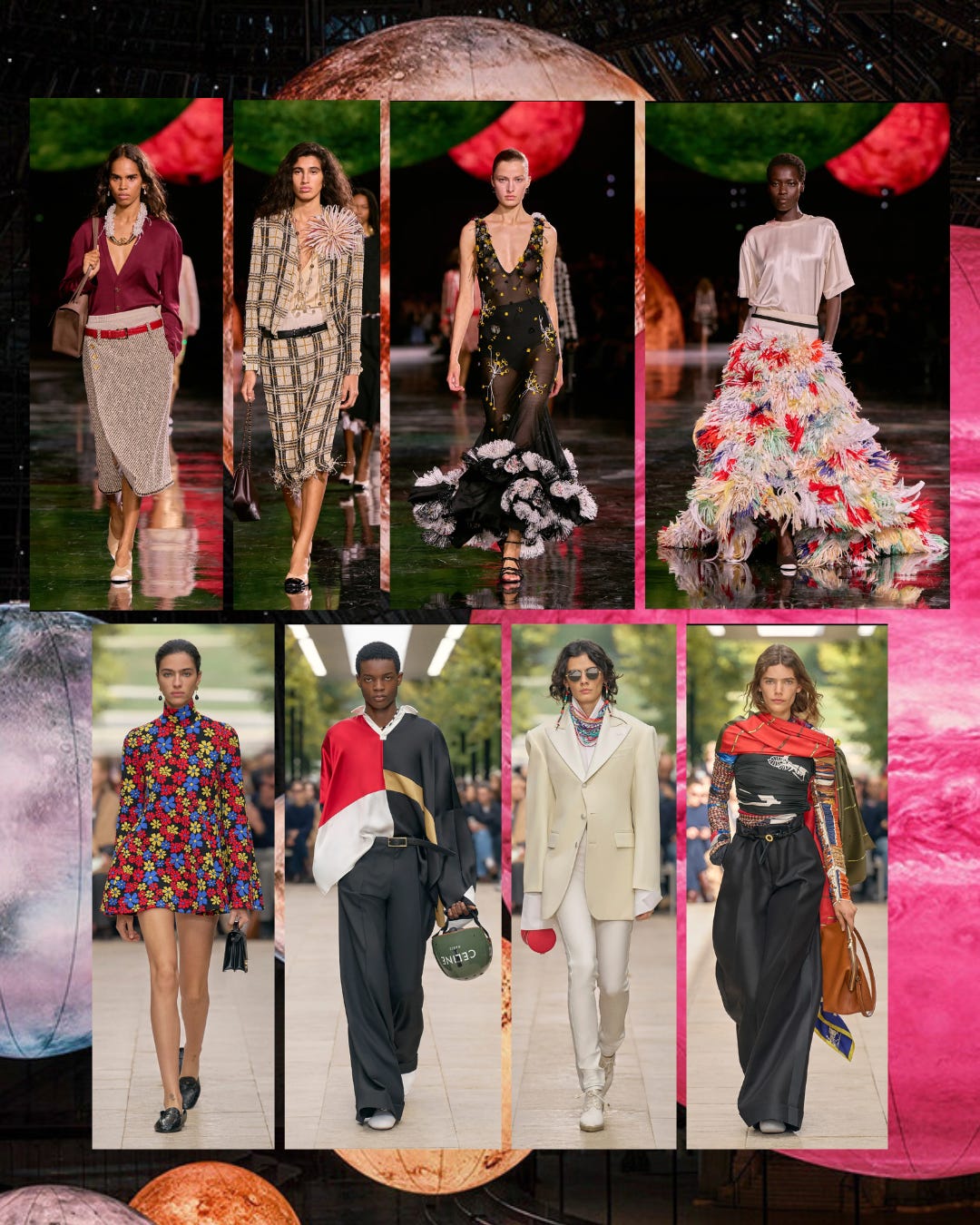
For his debut at Chanel, Matthieu Blazy transformed the Grand Palais Éphémère into a celestial dreamscape - an ode to Coco Chanel’s fascination with astrology. Beneath a canopy of orbiting planets and mirrored floors, he revisited the house’s signatures: the tweed suit, the quilted bag, the cap-toe shoe. Yet each was made his own. The once-weighty tweed was reimagined in silk and viscose, its new lightness mirrored in dropped waists and layers that moved as you walked. Bags were gently patinaed, skirts voluminous but wearable — perfectly caught between past and future and very much alive in the present.
At Celine, Michael Rider reframed the Parisian brand through his American lens. Rider kept the mod spirit and the scarf prints but layered in collegiate ease and color — a bit of preppy optimism meeting couture restraint.
Both shows were proof that emotion, not history, keeps heritage alive.
Warm Minimalist
Fewer pieces, more presence.
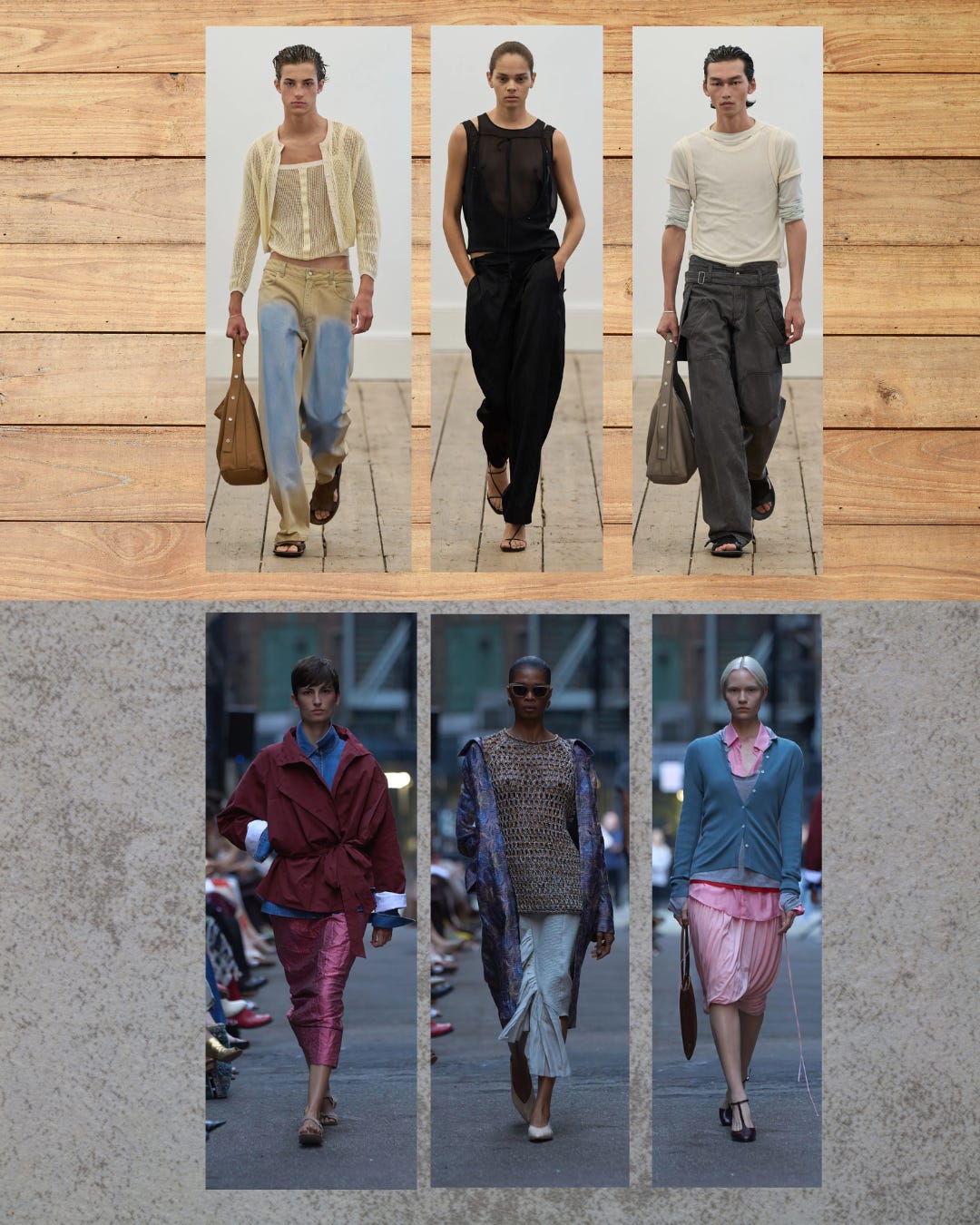
When minimalism works, it isn’t cold. It’s about warmth — the touch of wood against concrete, the fall of fabric, the restraint that lets emotion come through form. You see it in the details: the drape of a pant, the curve of a belt, the quiet rhythm between layers.
At Eckhaus Latta, that language came through deconstructed knits, soft tailoring, and glimpses of bare skin between layers. Mike Eckhaus described this season’s approach as “constrained” and “restrictive,” but there’s beauty in the constraint. Every mix of texture and cut felt deliberate from the flash of a waist, the layering of tanks and tees, and the barely finished hem that gives the look its soul.
At Rachel Comey, minimalism took on an urban warmth. In the alley behind her store, she worked in pops of blues, pinks, and maroon, where color was the punctuation, not noise. Her looks carried that studied nonchalance: effortless at first glance, but every detail considered. Ultra-fine materials hovered between ease and precision, restraint and release.
These shows remind us that minimal doesn’t mean simple, it means intentional.
Contemporary Luxe
Tailored precision, elevated materials, and craftsmanship.
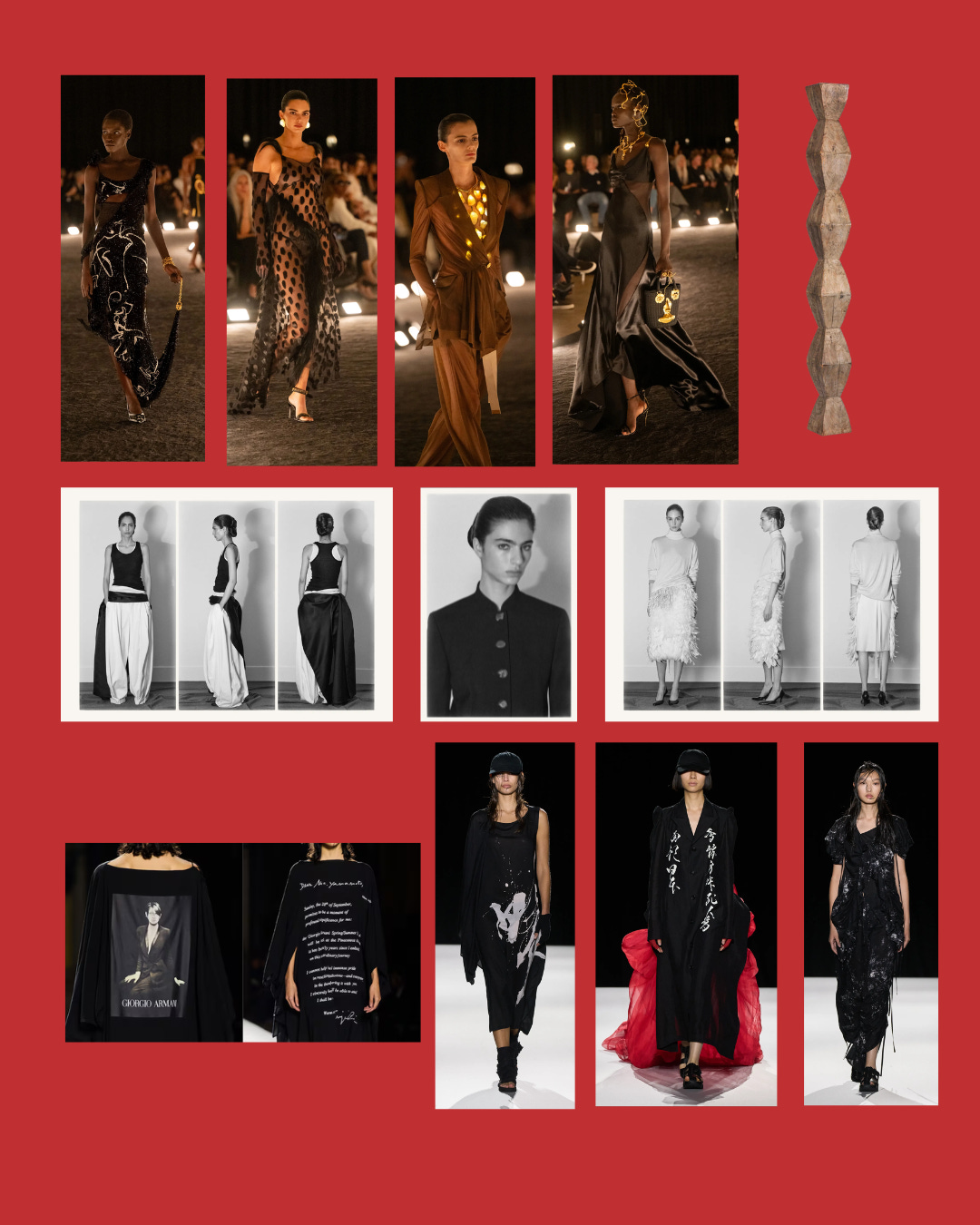
Daniel Roseberry’s show at Schiaparelli was inspired by the sculptor Brancusi (and the show was staged at the Centre Pompidou which recently exhibited Brancusi’s works) and became a dialogue between art and couture: sculptural bodices and jewelry that bordered on installation. In the past, Roseberry caught flack for having ready-to-wear collections that felt too much like couture, but now he’s applauded for exactly that. Roseberry shared, “What once felt like a liability feels like a superpower when it comes to how the clothes are performing. I didn’t want to dumb down the ready-to-wear at all”.
At The Row, the mood was pared-back and whisper-precise (no phones allowed at the show itself, instead they give you paper and pen to take notes). The Olsens’ signature restraint showed up in the tailoring, layering, and styling prowess that are the epitome of sophistication and ease. Their elegance lives in those micro-decisions, the kind that only reveal themselves when you look closely.
And then Yohji Yamamoto, ever the poet, his collection unfolded like a meditation on art itself, with garments marked by white painterly strokes, fringe, and deliberate shredding that recalled Sheila Hicks or Olga de Amaral. He even nodded to Giorgio Armani’s legacy with a dress printed with an invitation to Armani’s 50th-anniversary show and a campaign image on the back. Yamamoto has always gone to the beat of his own drum but never shies away from honoring those who have shaped the craft alongside him.
What sets these designers apart is their commitment to the art itself. They refuse to trade craft for commerce. Instead, they see their role as essential to the fashion landscape - to keep elevating the game, one perspective at a time.
Moody Classic
Cinematic, romantic, and timeless.
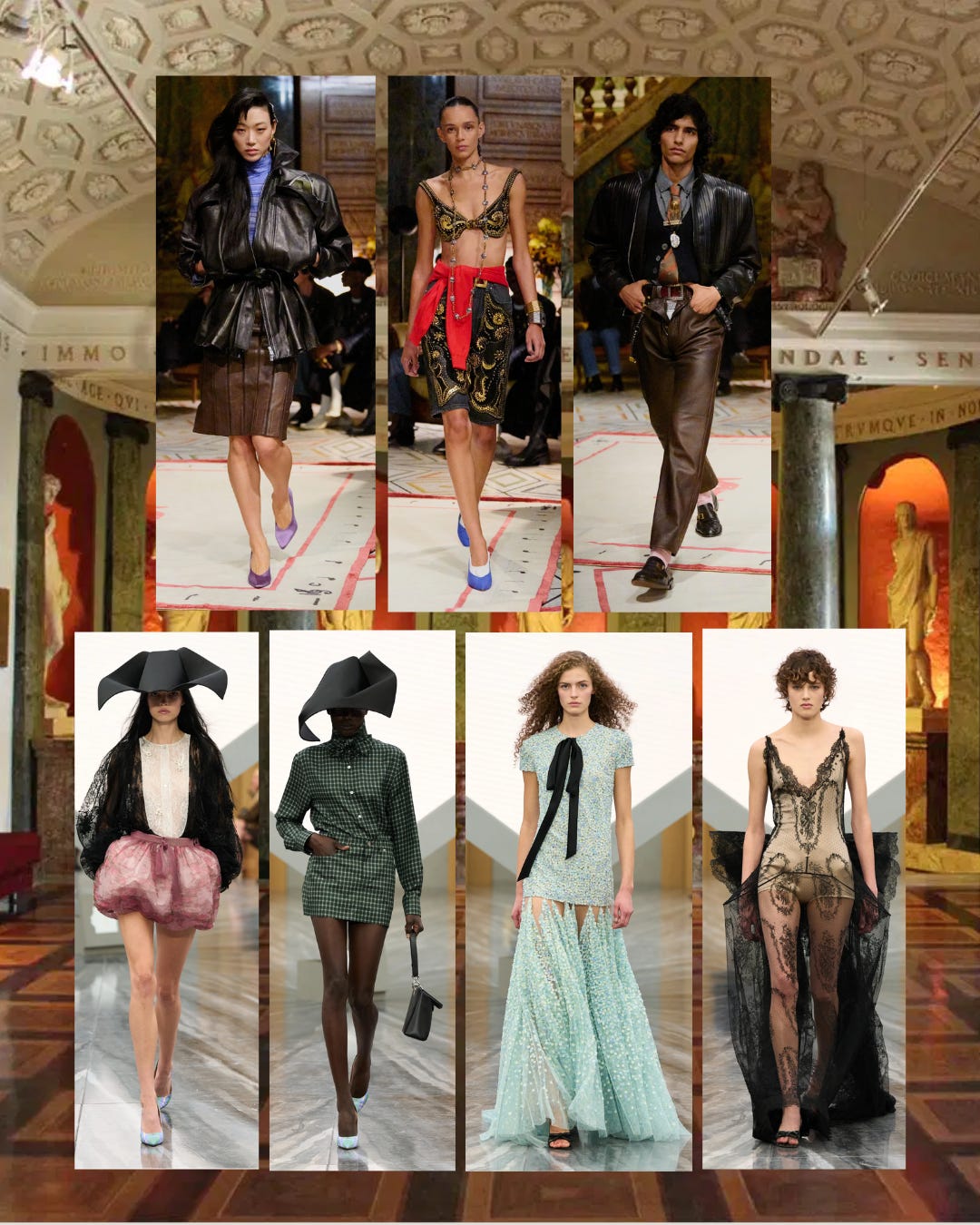
Moody Classic has always lived between eras. It borrows from history but keeps one foot in the present, balancing restraint with drama, light with shadow. This season, that tension found its most cinematic form at Versace and Dior.
At Versace, Dario Vitale’s debut unfolded inside the Pinacoteca Ambrosiana in Milan — home to Caravaggio’s Basket of Fruit and one of the world’s largest collections of Leonardo da Vinci drawings. That setting alone told you everything. The show was steeped in art history and emotion, referencing the house’s legacy and Vitale’s own (his mother was an avid collector of vintage Gianni pieces). Cuts were sharp and sensual, drenched in deep tones reveling in a chiaroscuro of silk and shadow.
At Dior, Jonathan Anderson’s debut took that same reverence for the archive and gave it a looser, playful grip. He treated Dior’s codes, the Bar jacket, the bow, the sweeping cape, as an entry point to push the drama and nostalgia. Anderson describes his mission at Dior as “blurring the idea of decades together”, lifting the burden of too much relevance.
Both shows understood the emotional pull of the past without falling into repetition. They reminded us that romance, when done well, isn’t nostalgic, it’s timeless.
I hope you enjoyed jumping into this rabbit hole that has all the flair, drama, nuance and depth that make up the best type of frivolous (and serious and important) pursuits. As in art, no one style may be fully you and there may be seasons where you are leaning into minimalism and others where bold patterns are you. And just as is true with art, its all about noticing what makes your heart sing and deserves a double take. It’s about finding and returning back to yourself - that’s the point of it all anyway.
Quick note: I’ll be out of town next week. See you back here in two weeks with more!
Images and details from show notes + designer quotes courtesy Vogue Runway